Musings on music, old, new, popular and obscure. Post punk, metal, hip-hop, funk, and rock in general. A music fan with a desire to lose boundaries on what should and should not be listened to writes about experience in music from a listener's perspective, hopefully unhindered by prior expectation.
Showing posts with label Dad. Show all posts

Sunday, August 5, 2012

Symphony of the Earth--One Fewer, and We Might Have the Question -- The Elephant Kashimashi

There are a dozen, or at least a half-dozen, ways to start writing about this. And it's really just two songs. Well. Two songs, two instrumental versions of those songs, and seven live recordings.

The opener that has always entertained me is that this band fell into my lap by chance. I was studying Japanese (which has turned out poorly) in college and was handed a random "Best Of" for Christmas about eight or nine years ago. It was a band no one, including me and the one who gave it to me, my father, had ever heard of in our area. No friends, searching for them online tended to turn up sites in Japanese, if anything. The cover wasn't an awful lot of help, and of course all notes were in Japanese. I was going out to visit friends, though, so I put it on in my car stereo as I drove out, having sampled it briefly at home. They were noisy, boisterous, and rougher than the sounds typically associated with Japanese music in the modern age, especially that theoretical entire genre of "j-pop," which tends to be bouncy and slick more than anything else.
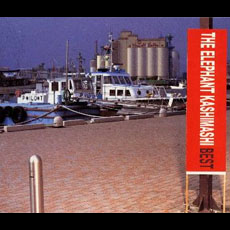

Of course, that compilation started with an album track from 24 years ago, the rather noisy "Fighting Man," simply transliterated into katakana instead of actually translated. Of course, Japanese music of any popular variety is notorious in English-speaking countries for its broken-up nature and habit of using English awkwardly at best, and totally uncomfortably at worst, jammed into the middle of otherwise entirely Japanese lyrics, often seemingly for no good reason. While it does compose the chorus of that song, it makes no other appearances, beyond that refrain of "Baby, fightingu man!"

Wednesday, June 20, 2012

Had I Known You Better Then, I Would've Said Those Three Ol' Words -- Daryl Hall/John Oates's Abandoned Luncheonette

While I do try to keep (negative) reputations from influencing what unfamiliar things I will listen to, it does mean that they're often things I won't go after quickly. Artists with a reputation for flaccid or sneer-inducing pop I tend not to judge near so harshly, but not knowing which will really strike a chord with me means I'm wary of touching any of them without some point of familiarity. Mix in the fact that, my current and varied and peculiar knowledge notwithstanding, I used to have no idea who wrote or sang this song or that one and it doesn't help much. Of course, those who were at a point of absorbing a lot of those facts when artists were regularly and visibly releasing music can say, "They did..." and hum or sing a few bars, sometimes even just name a song and things will fall into place. Recommendations when I stumble into something, too, can help with this.

One day a few years back, I was flipping through a crate of duplicate and unwanted records my father had, taking what I wanted for myself. After picking out the known quantities--a copy of my favourite Beach Boys album (Surf's Up) as well as the double-LP reissue that combined their later album So Tough by "Carl and the Passions," named for a pre-Beach Boys group Carl was in, packaged with Pet Sounds; The Association's Greatest Hits; and newly-appreciated-to-me Sparks' debut under that name, A Woofer in Tweeter's Clothing (they were called Halfnelson and released a self-titled debut under that name, but renamed themselves Sparks and the album was reissued as eponymously as that instead), I was left sorting through mostly obscure disco, pop, and electronic music, the dance/electronic end very much derived from the taste of one of his friends. Things like Michael Garrison's 1979 debut In the Regions of Sunreturn, which is out of print even on CD, or Larry Fast's 1975 debut as Synergy, Electronic Realizations for Rock Orchestra, which is an utterly fantastic album that made the charts in its day--#68, anyway--but is sort of lost today. There were some other in-between sorts of known quantities like Golden Earring's 1975 album Switch, sandwiched between 1973's Moontan (which spawned the huge hit "Radar Love") and 1982's Cut (which spawned the other big hit, "Twilight Zone").

There was one other album that managed to jump out at me, simply because it looked a bit odd, had names I knew, and had those names arranged in a peculiar fashion:


Sunday, June 3, 2012

Welcome to Hollywood, Hey Man, Can You Spare a Quarter?

Scattered in bits and pieces across the internet (including on this blog in a few places, like my purchases from Record Store Day this year, my discussion of unusual voices, and as performer of one of my favourite b-sides), my love for Leon Russell is not even close to a secret. Indeed, I've even a noticeable affection for the look he rocked throughout the 70s in particular: salt-and-pepper beard, top hat, and hair to his shoulders.

But I'm actually here to talk about something else in Leon's career, besides his "solo" work that began with 1970's Leon Russell. I do forget on occasion that Leon's come up a bit in the public conscious since Elton John began to emphatically display his love of Leon's work, enough that they released a joint album, The Union, in October, 2010. Still, the parts that jump out to me are often stranger bits, less known bits or more uncommon bits--simply because I was not given a purely singles-based method of hearing the man's work.

It all came from my father's encouragement to listen to Gimme Shelter: The Best of Leon Russell, a two-disc anthology of work only released with the man's work visibly attributed to him. In large part, this meant it covered his solo work. But that anthology is (was--it's out of print) chronologically arranged, by effective recording time, rather than release. That means the set opens with "Hello, Little Friend," from a 1971 album entitled Asylum Choir II, credited to "Leon Russell and Marc Benno." At first glance, it appears to be one of a number of duo albums Leon did (another big one would be One for the Road with Willie Nelson). However, this is actually the sequel to the comparatively obscure Look Inside the Asylum Choir, credited to, well, The Asylum Choir, released in 1968.

Sunday, May 13, 2012

Didn't Know What I Was Looking for, Maybe Just a Blanket or Artifacts -- Whiskeytown's Strangers Almanac

Its been a busy few weeks, so I've been a bit quiet. Tonight's not much of an exception: I'm going to see my favourite band tonight (Coheed and Cambria). I've been dancing around genres of late as always, from sampling Dead Boys and more Sparks to Luna and the solo albums of Fugazi's Joe Lally to my first round with Cocteau Twins. I've spent most of my time fiddling a bit with "alternative country" and "country rock" (the latter courtesy of Gram Parsons's Reprise albums with Emmylou Harris). The most consistent culprit for this is a band that was originally from and heavily recorded in this area: Whiskeytown. Ryan Adams has gone on to endless solo work (usually described with a pithy comment about the sheer volume of it), and I've found myself stuck on a normally maligned album of his (Rock and Roll), but Strangers Almanac has a veritable stranglehold on my listening, be it here at home, in the car, or wandering around playing with my Toshiba tablet.

This isn't the place to get too much into the causes of emotional resonance, but it's worth noting that that element is a strong part of what is pushing it up the listening list so readily and regularly of late, and it means something that it has the resonance, even if the "why" of it isn't immediately relevant here.

Sunday, May 6, 2012

Guess Who Just Got Back Today? -- Thin Lizzy

Around high school and college, I had a habit of trying to avoid limiting myself to singles and familiar tracks from any given artist as a means of making sure I didn't unintentionally and unknowingly find myself without some lesser-known but glorious music. It also helped to know where to start with artists who never really had a "Greatest Hits" due to their relative new-ness or because it simply hadn't happened in any reasonably available fashion. Of course, the fact that albums are some of the more commonly discussed in circles surrounding music history encouraged this as well, nevermind the affinity shown by musicians toward making "albums" as a cohesive unit of music starting sometime in the late 1960's, which is the beginning of when I find most music interesting.¹

As a result, I spent a lot of time in those days with complete (though simple) discographies from artists who caught my ear, thinking it would be rather peculiar for anyone to write a number of songs that I liked and only that handful--or, really, even a single song. I suppose the logic ran that if the band or artist was still known and discussed ten, twenty, thirty years on, there must have been enough of value in all their work to maintain a fanbase after their initial charms might have worn off. I've mentioned that XTC pushed me to eventually pursue more complete (sometimes excessively so) discographies, but that came from pushing through album after album, getting scattered first by things like well-regarded EPs from modern artists.

Still, for quite some time, many artists from the 1970s and 1980s in particular were available primarily only via their album-styled works or greatest hits compilations, rarities being not-oft discussed, let alone easily found. Heck, I didn't realize how often bands would even bother with them in the major label, popular-mainstream of things until stumbling into things like The Cars' Just What I Needed anthology, or The Police's Message in a Box set (which actually isn't a box, for the record).

One of the bands I picked up in those days, alongside less traditional (though possibly more loved) artists like Tom Waits--leading, incidentally, to my fascination with his lesser-regarded earlier works--was Thin Lizzy. Of course, most people think of them from that 1976 smash hit (assuming they even know what band was behind it) "The Boys Are Back in Town," and I was not much of an exception. Now, to spare you just a bit, let's drop that song in, to give those unfamiliar a simple hook to start from, via that very song:


Saturday, April 7, 2012

And It's Something Quite Peculiar... -- The Church

"They're Australian?" -- My father, with some measure of incredulity, reflecting not a low opinion of the Australians, so much as the fact that their country of origin had not shown through to him.

"Yep," said I, knowing that the country I'd identified as my "favourite" in my youth (due to my affection for its peculiar wildlife, including my favourite animal, the platypus¹) was responsible for a number of artists I had, by then--a few months before today--identified as quite enjoyable. My love of INXS is no secret, but I'd recently discovered not-Aussie-but-Kiwi Split Enz via Gillian Armstrong's Starstruck (that is my own review of the film, though I make no mention of the band responsible for writing the songs, and it's not exactly my finest movie review--to be clear and avoid angering residents of either island, they are from New Zealand, but were on major Aussie label Mushroom), an accidental discovery years ago of X, not to be confused with the far more famous Los Angeles band, some years ago, AC/DC (though a bit garbled, as the Youngs were born and mostly raised in Glasgow, Scotland), the Bee Gees (similarly to AC/DC, they emigrated to Australia, albeit from England), and milder interests in Men at Work. Recently, I've decided I might give Midnight Oil a shot as well, and have been pleased so far.

But those bands aren't, any of them, the band I'd just informed my father had come from the furthest hemisphere from our home in the United States. No, that band is one that is generally known for a single song or not known at all: The Church.

Now, if your immediate reaction is "Who?" then I can give you the only answer likely to make sense to you--if this doesn't do it, you're not going to get it (or possibly from, say, Australia, and know their first hit, "The Unguarded Moment" better).

Friday, March 30, 2012

That Make a Small Portion of the World Cry -- B-Sides

There are, I don't know four or five major types of bonus tracks included on reissues and special versions of albums: studio out-takes and "alternate" versions, live tracks, b-sides, BBC sessions (which are occasionally live), and non-album singles. Similarly, there are about four major types of compilation: the best of or greatest hits, which typically collects singles with an occasional popular deep cut;the live album, which may contain a concert or two, or tracks excised from a variety of performances, either on a single tour or throughout a band's career; rarities albums that contain a mix of the "bonus tracks" I've just listed, and occasionally focusing exclusively or almost exclusively on one of them like b-sides or BBC sessions; and "comprehensive" (sometimes!) anthologies of a band's entire career that typically contain all of the above, though they're sometimes just pretentiously named "best of" compilations.

Now, there's debate, concern, wariness, and about every negative (and probably every positive) attitude you can think of when it comes to these "extra" or "bonus" tracks. Some people are annoyed when they interrupt the repeat flow of an album, when playing it numerous times in succession on a CD player or the like. Others think it's a cheap gimmick to gouge people for money. Some people just find them extraneous junk and trim them away in digital form or just eject the CD when the album proper ends. Some artists or labels acknowledge this and program in an extra bit of silence to separate the album from its errata, often using the "negative space" that CD technology allows (I'll talk more about this some other time, as it's actually quite interesting), or doing like Rhino did with their 2008 Replacements reissues, and sticking in an audio cue, which, in that case, was the sound of someone walking to a door and locking up to leave (which I appreciated at the end of "Here Comes a Regular," but was disheartening to find on every other album, including the far more raucous Sorry Ma, Forgot to Take Out the Trash or Stink, where it was less appropriate to the song it followed). They're a mixed bag in "anthologies" and the like, too, being seen in the same light as "valueless filler" to some, and the entire point to others.

Me? I love them.

Indeed, for whatever it says about me, there's little I love more than dissecting these extra tracks--or, better yet, whole compilations of them!--and discovering where they came from, the context they originally appeared in, and how they were originally presented, if at all. My digital music database is filled to the brim with excessive information, like replacing an album title with the name and location of a studio for "unreleased" tracks, which I arrange by their recording dates. It's interesting to find a studio appear in common between seemingly disparate artists, or to find a studio that has seen a huge chunk of a genre come through it. Trident Studios in London, for instance, saw Harry Nilsson recording for Son of Schmilsson, David Bowie recording for many of his earlier albums--and the Buzzcocks, recording demos shortly after Howard DeVoto left to form Magazine.

But let's pare me down here, and for now, let's talk about my favourite of these options: The B-Side.

Thursday, March 29, 2012

What Do You Call That Noise That You Put On? -- XTC and Obsession

This is pop?

Right now I'm listening to the Replacements and dipping into some early 90s hits for my own entertainment. I've been listening to Paul Westerberg's (of the Replacements) solo material for a lot of the day, spent last night listening to Ryan Adams and the rest of today listening to early Bee Gees, Dinosaur Jr, Meat Puppets, and Badfinger.

Despite all that, though, I went out to Charlotte's Manifest Discs and Tapes, which I last visited about eight years ago, yesterday, and though I walked out with some of the Ryan Adams and Meat Puppets I just mentioned (as well as some long-desired Thin Lizzy and Church reissues), the find of the night was an object that's been in my peripheral vision for a while, then suddenly went out of print. I'd seen a copy at my old friends CD Alley but it had even left there--and they often have box sets that just hang out until they go out of print and one of us stumbles in and goes, "Hey, waitasec..."

Somehow, this thing was sitting there with that TWEC-style sticker¹ denoting their online usage of TWEC's SecondSpin.com (not worth linking to, I'm afraid) and consigning many of their prices to absolute weirdness (see: unusually long footnote). Sometimes a great deal, sometimes a horrendous one not worth touching. Indeed, this particular item is out of print, as I noted, so that makes the price a huge gamble. The list price, when in print, was around $60, and that's become the starting used price for most of the year. This one, though, was marked $37.99. So, screw anything else I was going to find--this was coming home with me.

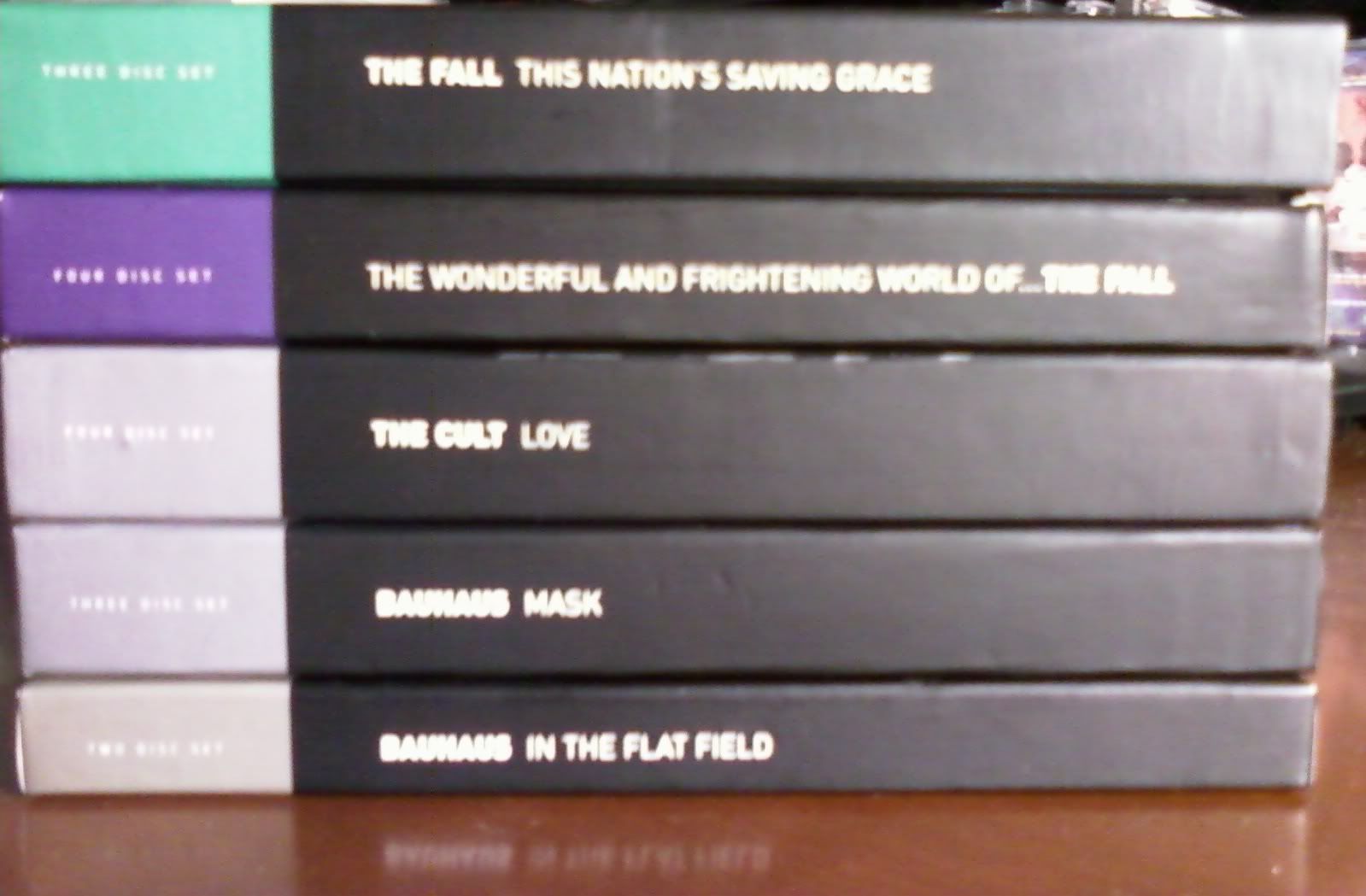
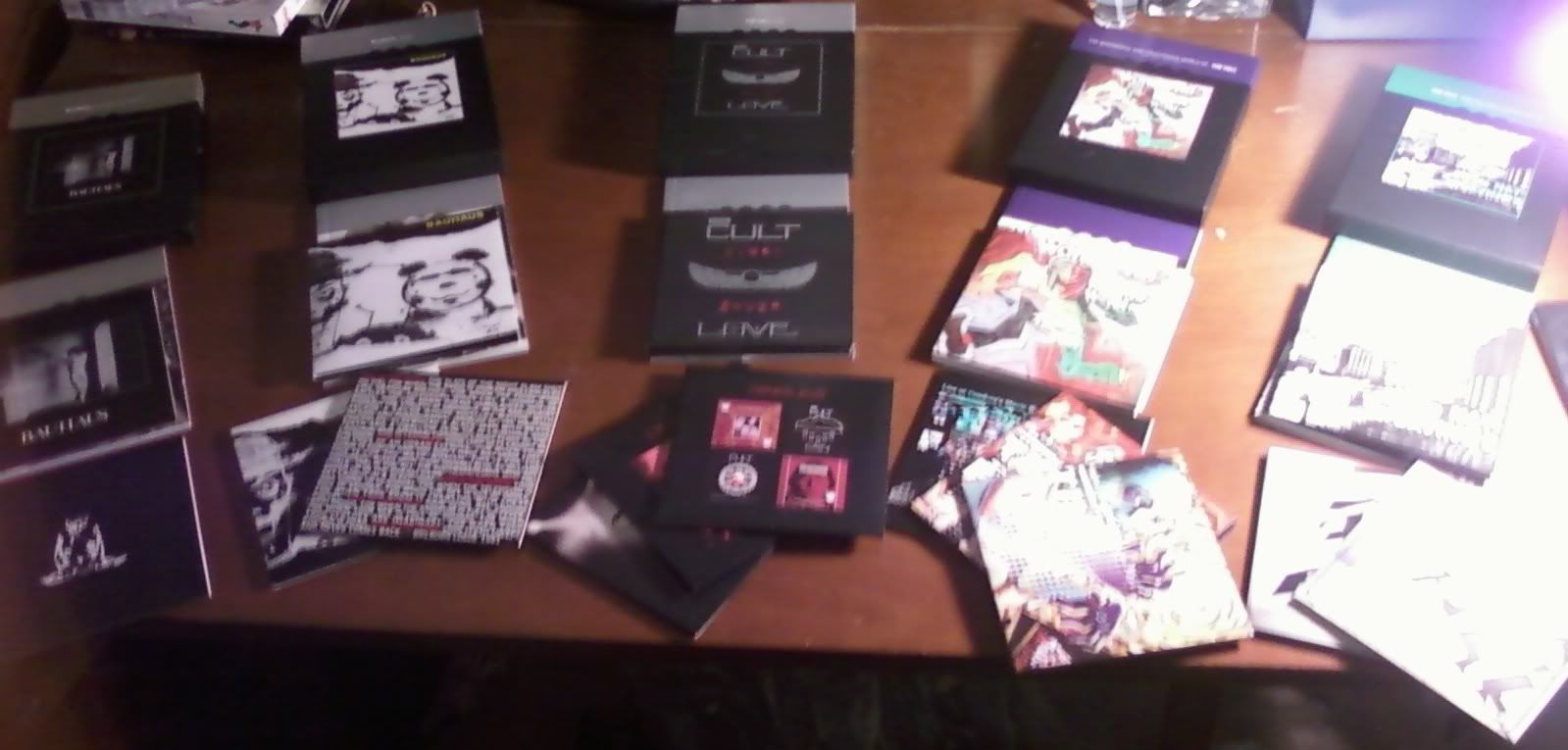
So, what was "this"? Well, here, of course, is a picture:

Monday, March 19, 2012

But I Don't Really Need It If I'm a Big Star

Most of the bands I write about, they have not only got followings, they have presence, be it hits or a reputation. Once in a great while, I stumble into an artist purely by chance, whether the name just sounds interesting, I like the cover art, or the extremely rare instances of compilation and split appearances. Most of the time, though, I hear the opinion of someone I find interesting, hear a band name over and over in awed tones, via label or artist association, or any number of entangled methods that are thoroughly indirect and require existing experience.

To be honest, most of the ones I find on my own, for all that I love them, are not bands I will zealously advocate to others. I had a subscription to eMusic once upon a time--back when they were a "fee per month, unlimited downloads" service, and I started going through their artists alphabetically as they seemed interesting. This is actually how I know the band !!!, and have done since their self-titled first album¹ but some of the others are a lot more obscure and remain as such, like Atomic Bitchwax, Aspera Ad Astra (who later changed their name to Aspera, and were obscure enough that I added their bassist to my AIM buddy list and spoke to him on there, and he was appreciative, not creeped out), and 2 Lone Swordsmen--though they have appeared in a few independent electronic discussions and such.

To find some great band, some secret, hidden one that people just don't talk about, at least around me, would be something of an achievement. It's not impossible, but having had my father's collection of 8,000 records growing up, as well as his love of music and tendency to pull a "Now, who's this?" on the whole family when a song came on the radio, I had a lot of things covered. Still do--he was just visiting for a Lyle Lovett/John Hiatt concert, and pointed me repeatedly toward mostly classic country artists, as well as attempting to expand my existing awareness of people like John Mayall (from whom I'd only heard the Bluesbreakers/With Eric Clapton album).

If that weren't enough, my best friend in high school and college was into punk when I met him, taught me a lot about it and grunge to an extent, plowed on into post punk later, and then got exposed to some classic stuff he'd never heard via being around me, but far more indirectly. And he tended to absorb and expand at a ridiculous rate. I still remember being around when he was first hearing early Kinks ("All Day and All of the Night" and "You Really Got Me" in particular), who I'd started to find boring and repetitive as compared to their later work.

Stumbling into my friend and ex-manager Gerald and various other people I've known has only made it that much more impossible to stumble on the truly hidden gems. Sometimes, too, I ignore a thrown off reference. Or the name sits and simmers, and then clicks much later.

So, it was pure chance that, one day, I was rooting through a box of newly-arrived CDs at my store--back when I worked for Borders--and saw this:

Thursday, March 8, 2012

Oh Man, Wonder If He'll Ever Know...

I've been distracted, quite happily, by the release of Mass Effect 3 for the past few days, but this is a music blog, not a gaming blog, so let me set that all in order here. It only makes sense, in a way, considering I spent most of that release day not playing that game but dealing with music.

Early in the day, Facebook led me to local (primarily used) record (all vinyl!) store Hunky Dory (they also sell glass, if you're into that sort of thing), and the probable need to abandon my plan to make music stores in the area something like a weekly feature, as the experience was so very positive and so thoroughly reinforced my view of the store that pausing on arbitrary and non-established bases seemed wrong.

What happened was this:
Owner Michael Bell posted one of his regular "Album of the Day" posts to announce new arrivals, and Tuesday it was The Jesus and Mary Chain's Psychocandy. I'd just been asking Brian at CD Alley about the CD reissues of all their albums, so it seemed almost fated. I asked quickly through Facebook for a price, got one almost instantly and went out to pick it up. Indeed, Hunky Dory has been good to me in this respect before: I'd made no planned purchases before, but when I go out on a spree and collect something like the New Order reissues, I am often somewhat knowingly overwhelming myself. What album do I start with? How do I get a "feel" for a band when I'm plowing through multiple albums and various b-sides¹ and errata? For some, the best approach is to pick up a compilation, like a generic Greatest Hits (which occasionally is part or even mostly miss), or even a quality one, or maybe a strange obscure one.

Sunday, March 4, 2012

Omnibus, take all of us, all of us take Omnibus

A lovely stack.
 
While I've been digging through post-punk, alternative rock and their relatives and descendants, my father has continued on his longest musical path, which relates most to roots, folk, 'alternative country' and the like. My appreciation of defunct local band Two Dollar Pistols confused both of my parents, as it was noted that they seemed "more like [your father's] music" by both of them. Of course, they played in the Borders I used to work in, as our Sales Manager, Gerald, was very invested in music and the local scene--and, despite a move, he continues to be invested in music. So I had a solid starting point for the band, and I've found that baritone vocalists appeal to me in some way that I'm still trying to figure out, as there aren't many around. Let's set that aside though, and I'll agree to talk about my father's interesting influence on my taste in music some other time.

Still, this meant that I was out looking for the reissue of Smashing Pumpkins' Gish¹ while trying to get him to a place he could find the new Dylan tribute Chimes of Freedom for a price he'd accept. He'd actually texted me some time prior to try and acquire a copy through my current job, but, well, nothing doing. I don't work somewhere that's going to carry niche compilations, however large that niche might be.
Related Posts Plugin for WordPress, Blogger...